


Most people already know exactly what they should be doing. Sleep earlier. Move their body. Drink more water. Stop scrolling 30 mins before bedtime. Read more. Eat better and eat mindfully. The information is not the problem. Everyone has the information.
What breaks down is the doing.
Consistently.
With needing temporary motivation from a 15 minute motivational video.
The importance of good habit formation isn’t really about knowing what’s good for you. It’s about building a life where the good things happen almost automatically, not because you’re disciplined in some impressive, effortful way, but because you’ve repeated them enough times that they’ve become just what you do normally.
That shift, from effortful to automatic, is what this blog is actually about.
Your Brain Is Doing Something Clever and You Should Know About It
Here’s something that completely changed how I think about habits.
Your brain is not trying to make your life harder. It’s trying to make it easier. Specifically, it’s constantly looking for patterns it can automate so that the conscious, thinking part of you can save its energy for things that actually need it.
This is why bad habits feel so sticky. Your brain didn’t choose them because they were good for you. It chose them because you repeated them. The 1 am snack. The morning phone scroll before you’ve even fully woken up. Reaching for something comforting the moment things feel stressful. These aren’t character flaws. They’re just patterns that got reinforced.
But here’s the thing that actually matters. The same mechanism works in the other direction. A healthy daily routine, built through actual repetition over actual time, eventually runs on its own. The morning walk stops being a negotiation with yourself. The water bottle gets filled before you’ve consciously thought about it. The journal gets opened because that’s what happens after dinner.
The January 1st Trap and Why It Gets Everyone
I think about this one a lot because I’ve watched it happen so many times.
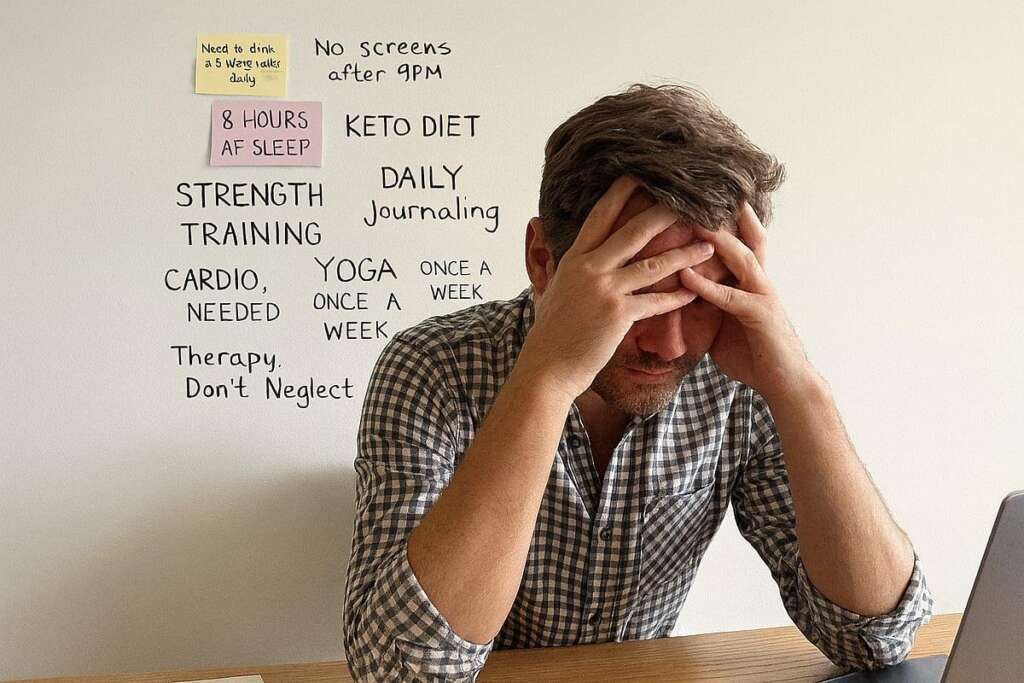
Someone decides to change. Maybe it’s a new year, maybe a bad week, maybe they just got inspired by something. And they make a list. Wake up at 5am. Exercise every morning. Meditate for twenty minutes. Drink three litres of water. Cut out sugar. Read before bed. Sleep by 10pm. Journal. No social media before noon.
All of it starts Monday.
By week two, sometimes less, most of it is gone. And the person doesn’t just lose the habits. They lose some of their belief in their own ability to follow through, which is honestly the more expensive cost.
The importance of good habit formation is understanding this. One thing at a time. Genuinely one. Do it until it doesn’t require effort anymore, until it’s just part of the day’s furniture. Then add the next one. It feels slow and it’s dramatically more effective than the alternative, which most of us have already tried.
What a Healthy Daily Routine Actually Is (And What It Isn’t)
Can we talk about how unrealistic most “morning routine” content is?
5am wake up. Cold shower. Hour-long workout. Meditation. Journaling. Reading. Healthy breakfast made from scratch. All before 8am.
For some people, in some seasons of life, some version of this works. For most people most of the time, it’s a fantasy that creates shame when reality doesn’t match it.
A healthy daily routine is not a specific sequence of impressive activities. It’s a structure that supports your actual life, your actual goals, your actual biology. The only things that actually matter are whether it’s realistic enough to do on a bad day, whether it’s consistent enough to become automatic, and whether it’s actually serving what you want for your life.
The Environment Trick Nobody Talks About Enough
This is the one that actually changed things for me personally.
Habits don’t just live in your head. They live in your environment. The objects around you, the layout of your space, what’s visible, what’s hidden, all of it is constantly sending quiet signals to your brain about what behaviour fits right now.
If your phone is on your nightstand, you will look at it first thing in the morning. Not because you decided to. Because the object in your environment triggered the pattern before your conscious brain was even fully online.
Make small changes like put a book on the bedside table and create a habit of reading at least 5 pages before sleeping. Replace the junk foods on the table with fresh fruit. Maybe try to delete the apps that increase your screen time.These are tiny, almost embarrassingly small changes. Yet they help a lot because at the end these small decisions create big changes.

Healthy Daily Routine: Why it matters
Daily habits and mental health are not separate topics. They’re deeply tangled.
Sleep doesn’t just affect how tired you feel. It directly affects how you regulate emotion, how you handle stress, how you make decisions, how resilient you are to the ordinary friction of a day.
Physical movement processes anxiety and stress in the body in ways that sitting with them just doesn’t. Routine itself, the simple predictability of knowing what comes next in your day, provides a quiet background sense of stability and control that reduces low-level anxiety in a way that’s easy to underestimate until you’ve experienced it.
Building a healthy daily routine is not a cure for anything. We’d never say it is. But it is genuinely protective. And for a lot of people, rebuilding basic structure is one of the first and most meaningful steps toward feeling more like themselves again.
Just Start. Smaller Than You Think Is Necessary.
Last thing. Really the most important thing.
Don’t design the perfect routine. Don’t wait for the right week or a clear schedule or the right mood. Don’t research it for three more days. Pick one thing, the smallest possible version of it, and do it tomorrow. Then do it the day after.
The importance of good habit formation is ultimately about the relationship you build with yourself. The one where you say you’ll do something and then you do it. Over and over, imperfectly, in small ways, across a long time. That relationship, more than any specific habit or routine, is what changes things.
At Hashtag Counseling, habits and daily structure come up constantly in the work we do with students and young adults. If you’re looking for support figuring out what actually works for your specific life right now, come talk to us.
Frequently Asked Questions
Q1. How long does it take to build a habit?
It can take anywhere from a few weeks to several months depending on the habit and person. Repetition matters more than timeline.
Q2. What’s the single best habit to start with?
Whichever one you’ll actually do tomorrow. Start with something small, specific, and attached to something you already do.
Q3. Why can’t I stick to my routine?
Most of the time we create routines that are too ambitious or the environment around us isn’t set up to support it. Simplifying the habit and changing what’s around you first helps a lot to stick to the routine.
Q4. Can a healthy daily routine genuinely help mental health?
Yes. Sleep, movement, and following a disciplined structure of life have direct effects on mood, anxiety, and emotional regulation.