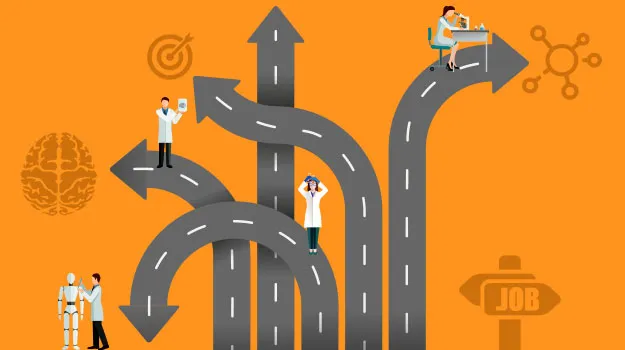


The answer to the question above depends entirely on who you ask. And more importantly, what you do next.
The interesting part is that most students are only aware of one side of the story, the one where AI takes over, humans become jobless, and the whole career-planning conversation becomes pointless.
Here’s the version that doesn’t make the headlines as often. A psychology graduate is designing ethical frameworks for AI hiring tools and getting paid better than her engineering batchmates. A regional literature student is helping a global tech company build AI that actually understands how people in smaller Indian cities speak and think.
None of them studied computer science. None of them saw this coming. All of them found career opportunities that didn’t exist when they started college and are now among the most sought-after roles in the market.
The AI economy isn’t arriving. It’s already here. So let’s get familiar with how you can prepare for this journey and boost your career growth.
Wait. Is AI Actually Taking Jobs or Creating Them?
Let’s get this out of the way first because it’s the question everyone is actually asking.
Both. At the same time. In different places.
Yes, AI is automating certain tasks. Repetitive data entry, basic content templating, routine customer service scripts, some forms of financial reporting. These are real and the displacement is real for people doing only those things.
But here’s what the headlines miss. Every technology wave in history destroyed certain kinds of work and created entirely new categories of work that nobody had words for yet.
AI jobs in India are following the same pattern, just faster. The roles being created right now are more varied, more interesting, and more human-centred than the ones being automated. And India, specifically, is becoming one of the most important AI talent markets in the world.

The Roles That Are Actually Being Hired For Right Now
Prompt Engineer: The Job That Sounds Made Up But Pays Very Well
So what does a prompt engineer do? A prompt engineer figures out how to talk to AI systems in ways that produce genuinely useful, accurate, creative outputs.
That sounds simple until you try it. The difference between a mediocre AI output and an exceptional one often comes down entirely to how the instruction was framed and written.
Prompt engineers understand the architecture of language models well enough to get them to do things that most users won’t be able to articulate well enough.
Companies are paying serious money for this skill right now. From Marketing agencies, law firms, hospitals to financial institutions, all of them are trying to integrate AI tools and desperately looking for people who know how to use them well.
A background in writing, linguistics, psychology, or logic gives you a genuine advantage here, not a disadvantage.
AI Trainer and Data Annotator: The Humans Behind the Machine
Every AI system that works well was taught by humans. Humans who labeled data, corrected outputs, rated responses, flagged errors, and shaped the model’s understanding of what good looks like. This work is called AI training and data annotation and the demand for it is enormous right now.
One of the most significant career opportunities in this space right now is in Indian language AI training.
India is a country with a huge population of people speaking in a ton of diverse regional languages. There are over 22 scheduled languages in India and most AI systems are still very weak in them. The people who can help build AI that actually understands Hindi, Tamil, Bengali, Marathi, Kannada, are working on some of the most important and well-funded projects in the field today.
Machine Learning Engineer: Yes, This One Needs Technical Depth
Okay, this is the one that actually requires coding. But let’s be specific about what that means.
Machine learning engineers build and train the models themselves. They work with data pipelines, neural networks, and large-scale computing infrastructure. This is a technical role that requires Python, statistics, and genuine mathematical comfort.
But here’s what’s changed. The barrier to entry has come down significantly. Online courses, open-source tools, and the explosion of accessible computers means that a motivated student with a Maths or Statistics background who puts in 12 to 18 months of serious learning can compete for junior ML roles. The IIT degree is not the only door anymore.
AI jobs in India in this category are among the highest paid in the tech sector and the demand consistently outpaces the supply of qualified people.
AI Ethics and Policy Specialist: The One That Needs Humans Most
Hardly anyone even heard about this role three years ago yet it’s now one of the most important in the field.
As AI systems become more powerful and more embedded in consequential decisions, hiring, lending, healthcare, criminal justice, the question of whether they’re fair, transparent, and safe becomes urgent. AI ethics specialists work on these questions from inside companies, governments, and research institutions.
A background in philosophy, law, sociology, public policy, or psychology is genuinely useful here, often more useful than an engineering background because the questions are fundamentally human questions dressed in technical clothing.
India specifically is developing its own AI regulation framework right now, which means the demand for people who can navigate the policy and ethics landscape is growing alongside the technology itself.
Content Strategist in the Age of AI: Not What You Think
Here’s something really interesting, AI made content easier to produce but it also made good human-led content more valuable.
Companies that flood the internet with AI-generated mediocrity are already seeing diminishing returns. The ones investing in genuine human insight, distinctive voice, deep research, and editorial judgment are winning the race.
Content strategists who understand both how AI content tools work and how to use human judgment to elevate above them are in a specific and genuinely interesting position. They can produce at scale without sacrificing quality. That combination is rare and it’s being paid for.
What India Specifically Brings to This Moment
AI jobs in India aren’t just about following the global market. India has specific advantages that are shaping a unique role in the global AI ecosystem.
India produces more STEM graduates annually than almost any other country. The pipeline for technical AI talent is enormous.
Language diversity. The challenge of building AI that works across India’s linguistic landscape is creating an entire category of specialized work, in NLP research, in multilingual model training, in regional language content, that is genuinely world-class in ambition.
And then there’s the domestic opportunity. India’s own digital infrastructure, UPI, Aadhaar, the data economy being built on top of them, is generating AI applications in agriculture, healthcare, education, and financial inclusion that are genuinely novel and genuinely important.
The Best Time to Start Was Yesterday. The Second Best Time Is Right Now.
The career opportunities that AI is creating in India are not hypothetical. They are being filled right now, by people who started learning six months ago, by career changers who spotted the shift and grabbed the opportunity, by students who chose to pay attention when it was still early.
At Hashtag Counseling, we work with students and graduates who are trying to navigate exactly this, figuring out which AI career path actually suits who they are, what to learn first, and how to position themselves in a market that’s changing faster than most institutions can keep up with.
This is genuinely one of the most interesting career moments in a generation. Come talk to us and let’s figure out where you fit in it.
Frequently Asked Questions
Q1. Do I need to have an engineering degree to work in AI?
No. Roles in ethics, content, product management, and training are all genuinely accessible from non-technical backgrounds.
Q2. What are the best AI jobs in India right now?
ML engineer, prompt engineer, AI trainer, AI product manager, and AI ethics specialist are all actively hiring.
Q3. How long does it take to become job-ready in AI?
Depends on the role. Technical roles need 12 to 18 months of serious learning. Some non-technical roles need less.
Q4. How do I know which AI career suits me?
That’s exactly what a career counseling session helps you figure out, matching your strengths to the right lane.