
So you’ve been telling yourself you’re fine for a while now. Maybe a few weeks. Maybe longer than that, honestly. Things feel heavy but not heavy enough to do something about. You’re functioning. Getting through the days. Showing up to whatever needs showing up to.
And somewhere in the back of your head, quietly, there’s this thought: something isn’t right. But you somehow manage to push it down. Tell yourself other people have it worse. Tell yourself comforting lies even though you understand pressing down thought is only making things harder.
I’ve heard this exact thing from so many people that visit my office. And the version I hear most often is from people who’ve been saying it to themselves for months before they finally walked in.
Psychological counselling is not something you deserve only when you’re completely falling apart. It’s something that helps long before that. But most people don’t reach out until the signs they’ve been ignoring for months have stacked up into something they can’t explain away anymore.
So here are ten of those signs. Read them honestly.

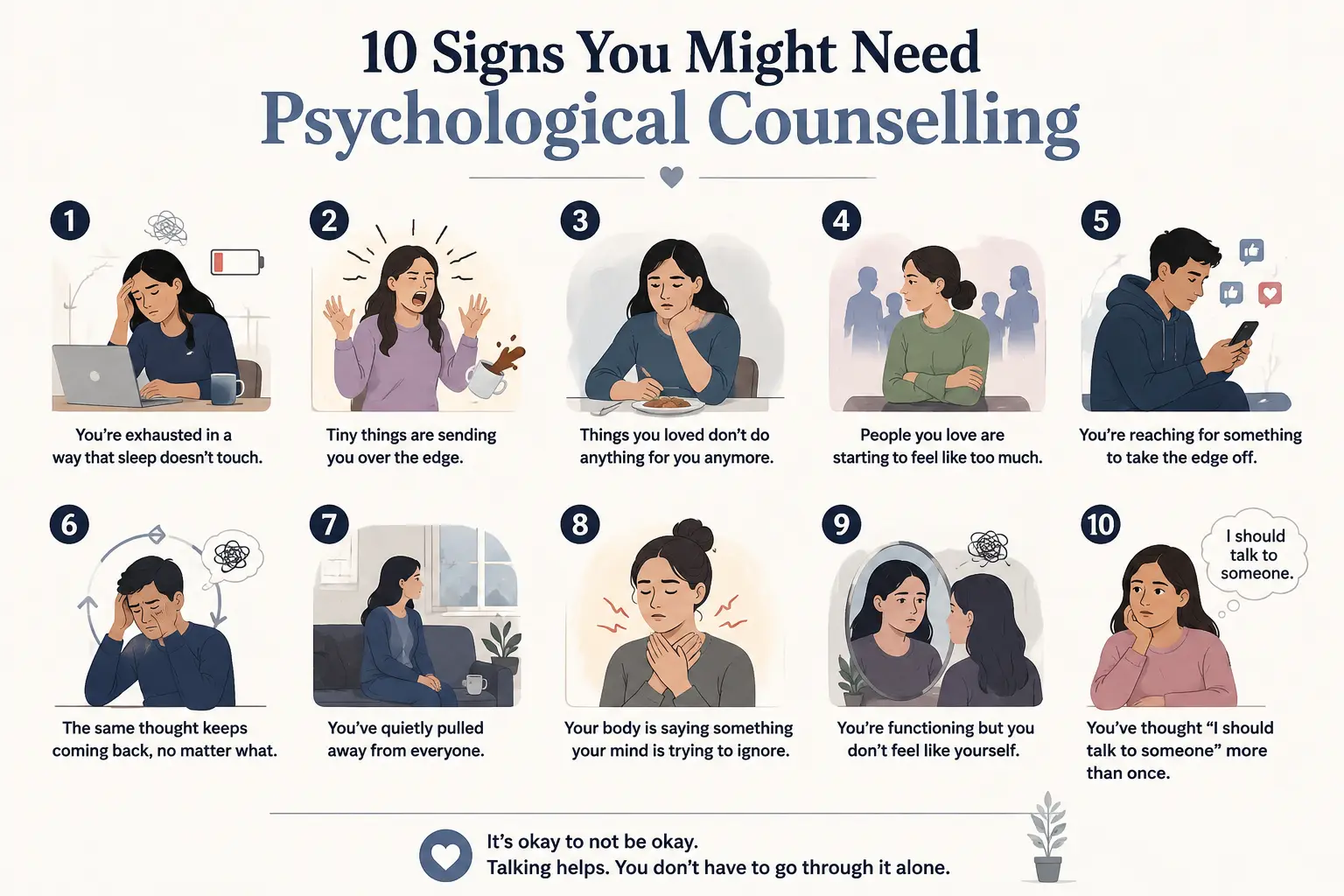
1. You’re Exhausted in a Way That Sleep Doesn’t Touch
Not tired from late night work. Not worn out from a hard week. Actually exhausted. This is what sustained emotional carrying feels like in the body. The mind works overtime holding things together, suppressing things, managing things quietly, and the body pays the bill. Rest helps muscles. It doesn’t touch whatever is sitting underneath.
When sleep stops being restorative and peaceful, something is working against it.
2. Tiny Things Are Sending You Over the Edge
Someone interrupts you in a conversation and you feel a flash of rage that makes no sense. A plan falls through and you’re devastated in a way that’s obviously about something bigger. You cry at something completely ordinary and then feel confused and embarrassed about it.
You’re not dramatic. You’re not overreacting. You’re depleted. And when you’re depleted, there’s no cushion left between the small things and your full emotional response to them.
Mental health researchers call this emotional flooding. Your regulation capacity gets used up by everything you’ve been carrying quietly. Eventually the little things break through because there’s nothing left to absorb them. Counselling gets at what’s creating the pressure, not just the moments when it spills.
3. Things You Loved Don’t Do Anything for You Anymore
Not bored with them. Not moved on. Just not interested anymore.
The thing you used to look forward to all week feels pointless. The music you loved sounds like noise. Food tastes like nothing. A friendship that used to feel energizing now just feels like another thing to manage.
This loss of pleasure, the technical word is anhedonia, is one of the quieter signals and one of the more serious ones.
4. People You Love Are Starting to Feel Like Too Much
This one is hard to admit because it carries guilt.
You love them. You know you do. But lately conversations drain you. You suddenly feel relief when plans get cancelled. You’re present in the room but not really there.
When the people closest to you start feeling like effort rather than comfort, that’s not a sign you don’t care anymore. It’s a sign that your internal resources are so depleted there’s nothing left over to give. That’s a mental wellbeing issue wearing the costume of a relationship issue.
5. You’re Reaching for Something to Take the Edge Off
Maybe it’s obvious. Maybe it’s subtle enough that you haven’t quite named it yet.
Scrolling for two hours because stopping means thinking. Eating in a way that feels less like hunger and more like filling something. Staying compulsively busy because the moment things go quiet, whatever you’ve been avoiding shows up.
These are coping mechanisms. They work in the short term in the sense that they create temporary relief. But they don’t touch the source. And over time they tend to build their own problems on top of whatever was already there.
Psychological counselling helps you figure out what you’re actually trying to cope with. That’s the thing that changes the pattern.
6. The Same Thought Keeps Coming Back, No Matter What
Like a playlist on loop.
Maybe it’s a thought that creeps in the moment you wake up in the morning. Maybe it’s a decision or a choice about your life that you took years ago which you still regret.
You try to avoid it by being busy but it’s a temporary solution. It doesn’t help breaking that loop you find yourself in. It breaks when whatever is underneath it actually gets addressed. That’s what counselling is for.
7. You’ve Quietly Pulled Away From Everyone
Nobody would necessarily notice. You haven’t announced anything. You haven’t had a big fight with anyone. You’ve just become gradually less available.
Messages sit unanswered a little longer. You say yes to things and then look for a way out closer to the time. Being around people feels like something you need to recover from rather than something that restores you. Withdrawal feels protective. And at the moment it is. But isolation and mental health are a bad combination over time.
8. Your Body Is Saying Something Your Mind Is Trying to Ignore
Headaches that keep returning. A knot in your chest that comes and goes without a clear reason. Stomach trouble that no doctor can find a cause for. A jaw that you realize, only when someone points it out, has been clenched for as long as you can remember.
The body and the emotional world don’t operate in separate boxes the way we pretend they do. What goes unprocessed emotionally tends to live in our body rent free.
9. You’re Functioning But You Don’t Feel Like Yourself
This one is the hardest to explain, which is exactly why most people don’t try.
You’re fine on paper. Getting things done. Nobody would look at you from the outside and see anything wrong. But inside there’s this dull, persistent sense that you’re not quite in your own life.
“I’ve lost myself somewhere” is one of the things I hear most often in first sessions. It’s not a breakdown. It’s a disconnection , a disconnection with one’s ownself. And psychological counselling is specifically designed for exactly this, not crisis management, but the slow, careful work of finding your way back to yourself.
10. You’ve Thought “I Should Talk to Someone” More Than Once
This one is the most honest sign of all.
Not because you read it on a list. Because it’s come up in your own head. Maybe in a quiet moment. Maybe after a particularly hard day. Maybe right now, reading this.
Most people who eventually come to counselling say the same thing when they’re on the other side of it: I wish I had come sooner. Not because things were worse than they needed to be. Because they didn’t realize how much lighter things could feel until they actually let someone help them carry it.

Why We’re So Good at Telling Ourselves We’re Fine
Honestly? Because we were taught to be.
Most of us grew up in environments where strength meant handling things quietly. Where asking for help was something you did only when you had no other option. That conditioning runs deep. It keeps people waiting until things are bad enough to justify asking for support.
But the truth is mental wellbeing doesn’t respond well to that logic. You don’t wait until you have a serious infection before seeing a doctor. You go when something has been wrong for a while and isn’t clearing up on its own.
Same principle. Perfectly applied.
Psychological counselling is not for people who are broken. It’s for people who are human and who are carrying something, and who would genuinely benefit from having a trained, non-judgmental professional in their corner while they figure out what to do with it.
At Hashtag Counseling, we work with people at every point on this. Some who’ve been struggling for years and finally decided to come in. Some who just have a persistent feeling that something’s off and can’t quite name it. Both are completely valid reasons to start. Neither requires a crisis to justify it.
Frequently Asked Questions
Q1. When should I consider taking counselling?
When your emotions and thoughts become too hard to manage on your own or when stress interferes with your daily life.
Q2. What if my problems don’t feel serious enough right now?
If it’s affecting your daily life and it’s been going on a while, it’s serious enough.
Q3. How is counselling different from talking to a friend?
A counsellor brings training, structure, and no personal stake in what you decide. That combination changes the conversation completely.
Q4. What if I don’t know how to explain what I’m feeling?
That’s fine. Most people don’t when they start. You don’t have to arrive with the words. You just have to be present.