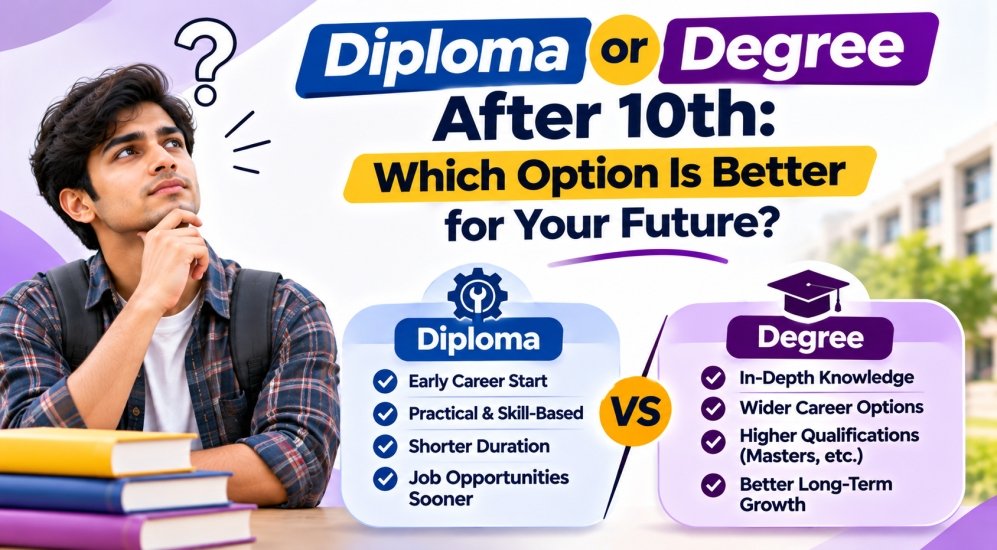
The Class 10 results are out. Friends are discussing which college they are joining, parents are asking about future plans, and admission forms have started appearing everywhere. But there is one question you may still be thinking about:
Should I take admission in a Diploma course or continue with 11th and 12th?
It sounds like a simple decision, but it can be difficult when you are not completely sure about your interests or what you want to do in the future.
Some students already know that they want to enter a technical field. Others want to explore Science, Commerce or Arts before choosing a particular profession. Both approaches have their own advantages.
The important thing is not to choose what everyone else is choosing. It is to understand which educational path makes sense for your interests, abilities and future plans.
First, Understand What Each Option Actually Offers
What happens if you choose a Diploma after 10th?
A Diploma course allows students to start learning about a particular technical or vocational field after completing Class 10, subject to the course’s admission requirements.
Instead of studying a broad range of school subjects, students begin focusing on a specialised area.
For example, students interested in technology and engineering may explore Diploma programmes in:
- Mechanical Engineering
- Civil Engineering
- Electrical Engineering
- Computer Engineering
- Electronics Engineering
- Information Technology
These programmes may include classroom teaching, laboratory sessions, practical assignments and projects.
A Diploma can be a suitable option for students who already have an interest in a particular technical field and want to explore it in greater depth.
What if you continue with 11th and 12th?
The 11th and 12th standard pathway gives students more time to explore academic subjects before choosing a specialised degree.
Students generally select one of the following streams:
Science: Often considered by students interested in engineering, medicine, technology, research and scientific subjects.
Commerce: Suitable for students interested in accounting, finance, business, economics and management.
Arts and Humanities: Offers opportunities to explore subjects such as history, psychology, languages, sociology, political science and communication.
After Class 12, students can apply for different undergraduate programmes depending on their subjects, eligibility and admission requirements.
Diploma vs 11th–12th: What Is the Actual Difference?
The difference is not simply about which course takes less time. The two pathways offer different learning experiences.
| Factor | Diploma | 11th–12th |
|---|---|---|
| Main focus | A specialised technical or vocational field | Academic stream and subjects |
| Learning style | Often includes practical and technical learning | More subject-based academic learning |
| Starting point | After Class 10 | After Class 10 |
| Specialisation | Begins earlier | Usually selected after Class 12 |
| Further education | Depends on Diploma qualification and admission rules | Depends on Class 12 subjects and eligibility |
| Suitable for | Students with a clear technical interest | Students who want to explore academic options |
Neither option guarantees a better career. The value of either pathway depends on the course, institution, student’s performance and future plans.
Which Path Would Make More Sense for You?
Instead of asking which option is better for everyone, consider what kind of student you are.
Situation 1: You enjoy practical and technical subjects
Suppose you enjoy understanding how machines work, solving technical problems or working with computers.
You may want to explore a relevant Diploma programme. It can give you an opportunity to study a technical field at an earlier stage.
However, do some research first. Make sure you understand the subjects, admission requirements and further study opportunities.
Situation 2: You are interested in several different subjects
Perhaps you enjoy Mathematics but are also interested in Business or Social Sciences. You may not have decided which field you want to pursue.
In this situation, continuing with 11th and 12th may give you more time to explore your interests before selecting a degree programme.
Situation 3: Your parents have suggested a particular course
Parents naturally want their children to have a secure and successful future. Their experience and advice can be valuable.
But choosing a course only because someone else recommends it may not always be the right decision.
Talk openly with your parents about what interests you, what you find difficult and what kind of work you might enjoy in the future.
Situation 4: You still have no idea what you want to do
There is nothing unusual about being unsure after Class 10.
You do not need to have your entire career planned at the age of 15 or 16. What you need is enough information to make your next educational decision thoughtfully.
This is where career guidance can be useful.
Things You Should Check Before Taking Admission
A course may sound attractive when someone explains its benefits, but it is important to look beyond the name of the programme.
Before making a final decision, check the following:
1. Admission Eligibility
Understand the minimum marks, subjects and other eligibility requirements. These can differ between institutions and programmes.
2. Recognition and Approval
Check the institution’s affiliation and the applicable approvals for the course. For technical Diploma programmes, verify the relevant regulatory requirements.
3. Course Subjects
Read the syllabus. Ask yourself whether you are genuinely interested in studying those subjects for the next few years.
4. Fees and Other Expenses
Compare tuition fees, examination charges, travel costs, accommodation and other expenses. Discuss the complete financial requirement with your family.
5. Future Education Options
This is particularly important if you are considering a Diploma.
Find out which higher education programmes you may be eligible for after completing it. Some Diploma qualifications may offer lateral entry opportunities into degree programmes, subject to applicable rules and eligibility conditions.
Do not assume that every Diploma automatically provides admission to the second year of a degree.
A Common Concern: Will Choosing a Diploma Limit My Future?
This is one of the questions many students and parents ask.
A Diploma does not automatically close the door to further education. Depending on the qualification and applicable admission rules, students may be able to continue with higher technical education or explore other eligible programmes.
Similarly, choosing 11th and 12th does not automatically guarantee admission to a preferred degree.
Both pathways require planning, effort and an understanding of the relevant admission conditions.
What matters is knowing where your chosen course can take you before you enrol.
How Career Counselling Can Help You Make This Decision
Sometimes students know their options but still cannot decide between them. They may have several interests, conflicting advice from different people or concerns about making the wrong choice.
A career counselling session can provide an opportunity to discuss these questions in a structured way.
It may help students:
- Explore their interests and academic preferences.
- Understand their strengths and areas for improvement.
- Compare Diploma programmes with academic streams.
- Identify educational pathways related to their interests.
- Discuss doubts about future career opportunities.
- Make a decision based on their own profile rather than peer pressure.
Career counselling is not about telling every student to choose the same course. It is about understanding the individual and helping them evaluate available options.
Guidance for Students and Parents in Silvassa and Thane
For students in Silvassa and Thane, selecting a stream or Diploma after Class 10 is an important step towards higher education.
The decision should involve both the student and the parents. Students should feel comfortable expressing their interests, while parents can help them understand practical considerations such as course fees, admission requirements and future opportunities.
Hashtag Counseling offers career counselling as one of its services. Students who are uncertain about their next educational step can explore guidance to understand their interests and consider suitable academic pathways.
Before You Decide, Ask Yourself These Questions
Take a little time to think about the following:
- Which subjects do I genuinely enjoy?
- Do I prefer practical learning or academic study?
- Am I interested in a particular technical field?
- Do I want more time to explore different subjects?
- Have I checked the eligibility and course structure?
- What further education options will be available?
- Am I making this decision because of my interests or because others expect me to?
Your answers can help you understand what matters most when selecting your next educational path.
Frequently Asked Questions
Is Diploma better than 11th and 12th after Class 10?
Neither is universally better. A Diploma may suit students interested in technical education, while 11th and 12th may suit those who want to explore different academic streams before selecting a degree.
Can I do Engineering after completing a Diploma?
Yes, eligible Diploma holders may be able to apply for engineering degree programmes through lateral entry, depending on the applicable admission rules and eligibility requirements.
Can I change my career direction after choosing a Diploma?
It may be possible, but the available options depend on the Diploma qualification, the next course’s admission criteria and any additional requirements.
Which stream should I choose after Class 10?
Choose a stream after considering your interests, academic strengths and future educational goals. Avoid selecting a stream only because your friends or relatives recommend it.
Should parents decide which course their child should take?
Parents should participate in the discussion, but students should also have an opportunity to express their interests and preferences. A decision made together is more likely to reflect the student’s needs.
Where can I get Career Guidance After 10th in Silvassa?
Students can explore career counselling services in Silvassa. Hashtag Counseling lists career counselling among its services for students seeking support with educational and career-related decisions.
Conclusion
There is no need to rush into a decision simply because admissions have started or your friends have already selected their courses.
A Diploma and the 11th–12th pathway can both be valuable, provided you choose an option that matches your interests and future educational plans.
Take time to understand the subjects, check admission requirements and explore what comes after the course. If you are still confused, seeking professional career guidance can help you look at your options more clearly.
Your first decision after Class 10 is important, but it does not have to define your entire life. Choose thoughtfully, stay open to learning and give yourself room to grow.