

You are 16-17 years old, you have no real world experience of a career, your mind is still developing, you don’t have proper career guidance after your 10th and 12th and suddenly everyone expects you to figure out what career you want to pursue for the rest of your life , isn’t it unfair? Well it is.
Your parents think you should pursue science stream and prepare for a competitive entrance exam, on the other hand the relative you barely see once or twice every year advising you to go for a MBA whereas your best friend is going into commerce stream and keeps saying just do what I’m doing.
And you are sitting in the middle of all this noise, trying your best to find out what YOU actually want. The advices and voices of different people starts to collide and suddenly you are floating a sea of confusion looking for a boat to rescue you from all this and career counselling is the boat you are looking for.
Choosing a career path after Class 10 or 12 is one of the biggest decisions you will make. And the pressure around it is real. But here is something nobody tells you clearly enough: you do not need a perfect answer right now. You need a direction. A starting point.

Why This Decision Feels So Heavy
The reason career guidance after 10th and 12th feels so overwhelming is because it feels like choosing a way of a life you are not quite sure of. So choosing a subject or picking a college feels like caging yourself in a finite world.
When you are in 10th or 12th class, life seems like a world full of infinite possibilities, you can be anything you want and anyone you want. You don’t carry a label with you, you are infinite.
But the truth is you are always infinite, you just need determination and will, that’s it. Most people you admire also didn’t have their entire life figured out when they were 16 or 17 years old.
it is not just about picking a subject or a college. It feels like you are deciding who you are going to be for the rest of your life.
But here is the thing. Most people change directions at least once. Most adults you admire did not have it figured out at your age either. The goal right now is not to find the one perfect path. The goal is to make a thoughtful decision based on what you know about yourself today, and stay open to evolving as you learn more.
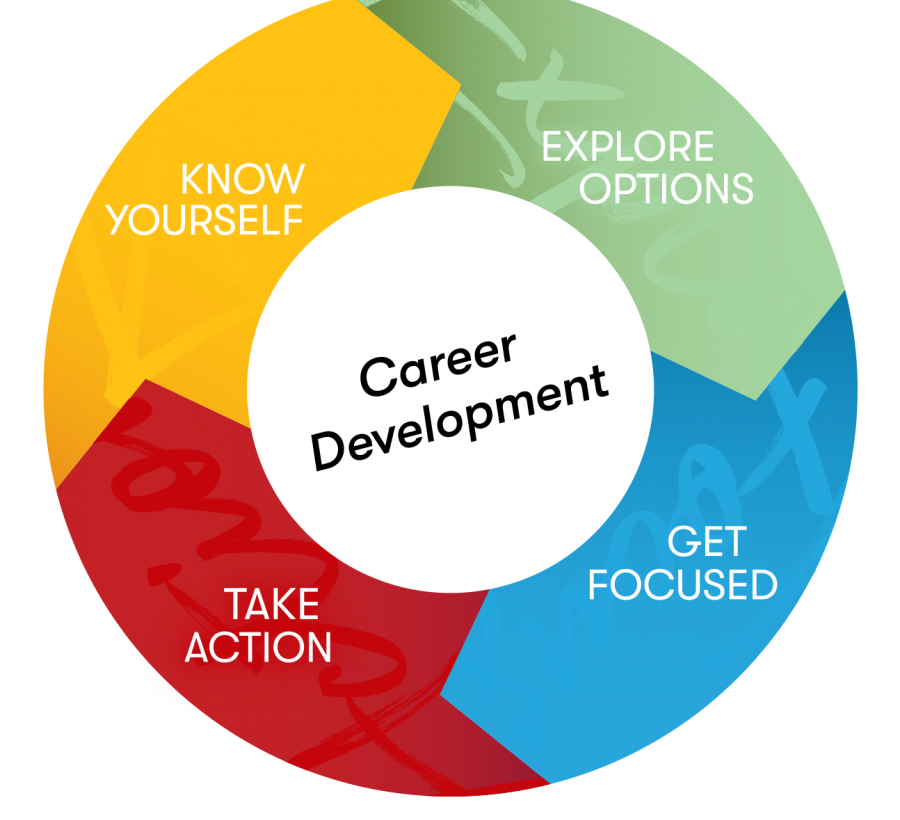
Start With Yourself, Not the Options
Most students make the mistake of starting with the list. Science, commerce, arts. Engineering, medicine, law. They look at what is available and try to fit themselves into an option.
It works better the other way around.Start with yourself. Ask yourself, what subjects feel enjoyable to you?What is your favorite hobby? What kind of life do you dream of?Are you more drawn to working with people, working with ideas, working with systems, working with your hands?
These are not trick questions. They are clues. And they matter more than your marks do when it comes to figuring out what kind of career will actually suit you long term.
Career guidance after 10th and 12th gets a lot more useful when you go in already knowing a bit about yourself. A counselor can work with that and help you connect the dots between who you are and what paths make sense.
Career Options After 10th: What Actually Opens Up Here
Class 10 is the first real step in the road.
Science, Commerce, and Arts or Humanities are the three broad streams. But within each of them, the options are much wider than most students realise at the time.
If you go into Science, you are not just locked into engineering and medicine. Fields like research, data science, environmental science, biotechnology, psychology, and architecture are all very much on the table.
Commerce is not only about CA or MBA. Marketing, finance, business analytics, economics, entrepreneurship, international trade, and human resources are all real and growing career options after 10th.
Arts and Humanities, honestly this stream gets the least credit and deserves so much more. Journalism, law, social work, design, content, psychology, education, public policy, and communication are all fields with real demand and real futures.
The point is, the stream you pick in Class 10 opens doors. It does not close them permanently.
Career Options After 12th: The World Gets Bigger
By Class 12, the options expand significantly.
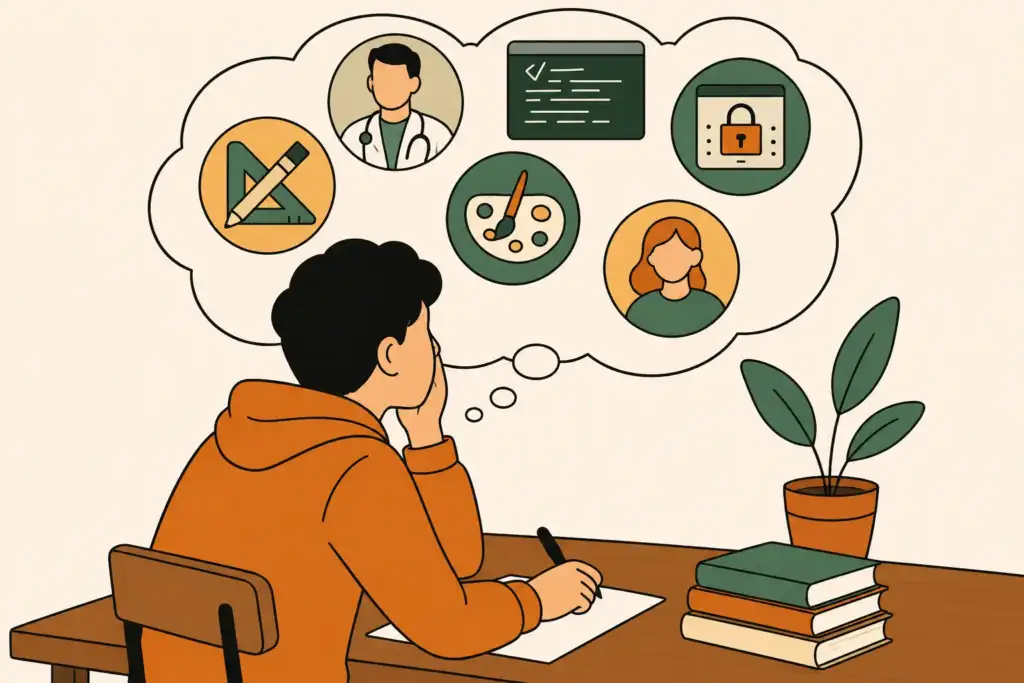
And that is where a lot of students freeze. Because suddenly it is not just three streams but thousands of options and hundreds of colleges, dozens of entrance exams, countless degree options, and everyone around you seems to have a stronger opinion than ever.
Your Class 12 stream has already narrowed your options down to a manageable range. So the career options after 12th looks like this :
- Science students will mostly be pursuing fields like engineering, medical, pure sciences, and some management programs.
- Commerce students have strong pathways into finance, accounting, business, economics, and law.
- Arts students have a genuinely wide range covering everything from mass communication to political science to fine arts to psychology.
The question at this stage is not just what can I do? but what do I want to spend the next three to five years studying deeply? Because the college years shape you a lot, and studying something you find genuinely interesting versus something you resent makes an enormous difference.
The Role of Marks vs the Role of Interests
This is a conversation worth having honestly.
Marks matter. Certain colleges and certain programs require certain cutoffs and that is just reality. But marks are not the same as ability, and they are definitely not the same as interest.
A student who scored 65 percent in science but genuinely loves biology and wants to explore research or health sciences will go much further in that field than a student who scored 90 percent but chose it only because it seemed like the safer option..
Marks get you into a program. Interest and effort keep you there, move you forward, and eventually build a career you actually want.
Talk to People Who Are Actually Doing That Work
This one is underrated and barely anyone does it.
If you are genuinely curious about a field, find a way to talk to someone who works in it. Not just a relative who says yes that field is good. Someone who actually does that job every day.
Ask them what a normal week looks like. What they like about it. What they wish they had known before starting. What skills they use most. Whether the field is growing or becoming more competitive.
You will learn more from one real conversation like that than from ten hours of Googling. And often you will either get much more excited about that path or realise pretty quickly it is not what you imagined. Both outcomes are useful.
Why Career Counseling Makes This Whole Process Easier
A good career counselor does not tell you what to do. They help you understand yourself better through proper assessments, give you accurate and current information about different fields and their real prospects, help you map your strengths to the right options, and help you walk into conversations with your parents with clarity and confidence instead of just feelings.
The students who get career guidance after 10th and 12th early tend to make decisions that actually fit them. They feel more settled during their studies because they chose something intentionally. And they go into the job market with a clearer sense of direction than students who just drifted from one step to the next.
At Hashtag Counseling, we work with students right from Class 8 through to college and beyond, helping them figure out their path in a way that is grounded in who they actually are. If you are standing at this crossroads right now, come talk to us. We promise it will be a real conversation, not a sales pitch.
Frequently Asked Questions
Q1. Is it normal to feel confused after your 10th or 12th?
Completely okay. That’s exactly why career counseling exists.
Q2. Which stream has the most career options?
Honestly, all three do if you explore them properly. The best stream is the one that suits how you think and what genuinely interests you.
Q3. How early should I start thinking about career options after 12th?
Class 11 is a good time to start exploring seriously so you are not rushing at the end of Class 12 under exam pressure.
Q4. Does career counseling actually help or is it just another test?
It’s much more than a test. It’s a conversation that helps you understand yourself and your options properly, which is something most students really need.